
The case
A hill, a fence, and ten years of asking.
This is the whole story: how the reservoir closed, what Thames Water has told us, and the specific thing we are asking them to agree to.
What happened
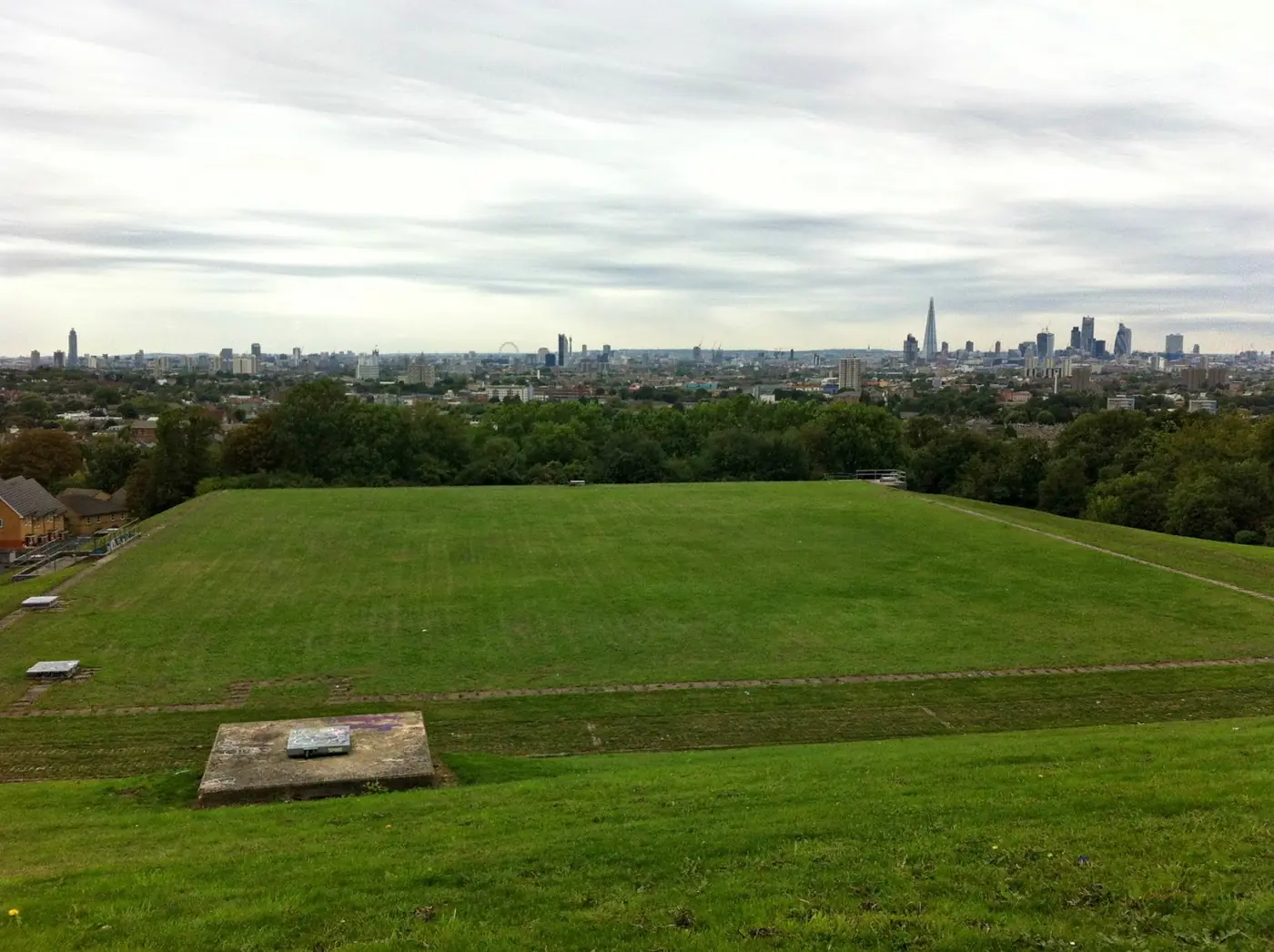
Nunhead Reservoir sits at the top of one of the highest points in south London. Its roof is a wide, flat field of grass, and from it you can see the whole city laid out. For years people walked up, sat on the concrete blocks, and watched the sun go down over London.
Then Thames Water put up a fence. Not a low boundary marker but a tall steel security fence, and it went up without the community being asked. In 2016 Thames Water publicly apologised for that lack of consultation. It explained that the reservoir supplies drinking water and that heightened security was required of it by government, and it confirmed at the same time that the leased land at Honor Oak, used as a golf course, was unaffected.
That last detail is worth sitting with, because it is the whole argument. Beechcroft Reservoir at Honor Oak is a covered Thames Water reservoir like this one. Aquarius Golf Club was formed at a meeting of the Metropolitan Water Board on 13 September 1912, and its course on the reservoir roof opened on 19 April 1913. It is still there.
“Located in Honor Oak Park, the club is uniquely situated on the Beechcroft Reservoir, a secure site owned by Thames Water.”
“Due to our location on a secure utility site, members benefit from a tranquil and private setting, free from public access.”
So the security of a covered drinking water reservoir has been compatible with regular, organised, weekly use of its roof for over a century — and the seclusion that comes with sitting on a Thames Water site is advertised to prospective members as a benefit. We are not asking for a golf course. We are asking for four supervised afternoons a year.
The campaign began with Rosanna Thompson, who wanted the reservoir back as a place people could use. Close to 7,000 people signed the original petition asking for the barriers to come down. Thames Water did not move, citing water safety and site security.
When Rosanna moved to Bristol, Jamie Bykov-Brett picked the campaign up and opened a line to Thames Water in August 2022. Local MPs and councillors were approached. Little came back.
Why it went quiet
The campaign relaunched publicly in 2024, and then it stopped. The honest reason is worth saying plainly: Thames Water restructured, and most of the people the campaign had been dealing with left. Two years of slowly building a working relationship went with them. There was no longer anybody on the other side of the conversation to have it with, and a campaign that consists of asking one organisation for something cannot continue when it no longer knows who to ask.
It is the same restructure that sits at the top of Thames Water's own list of reasons for the lack of progress, further down this page. It cost them the capacity to run open days. It cost the campaign the people who might have agreed to one.
We are trying again in 2026. The ask has not changed, because it was always modest. What has changed is that the campaign now holds its own signature list rather than relying on a petition platform that can quietly remove it, and it starts again from the position that this only moves when enough people are visibly behind it.
What Thames Water has told us
These are the five reasons given for the lack of progress since August 2022, in their own terms. We are publishing them in full because we think most of them are answerable.
Team restructuring and loss of staff
A significant restructure lost key team members, which affected capacity to organise events and manage usual tasks.
Resource reduction
The restructure also reduced resources, complicating the planning and execution of additional activities or events.
Operational priorities take precedence
The site is operational, and its primary function comes first, which limits the scope for hosting events.
External pressure to fix the basics
Public pressure to prioritise basic services and infrastructure maintenance over other activities has been cited as limiting the number and scope of public events.
Availability of operational team members
An event requires operational staff to be present, which is difficult to arrange without detracting from their primary responsibilities.
Our answer, in one line
Every one of those reasons is about staffing an event. None of them is a reason the site cannot be opened — they are reasons Thames Water cannot currently run one. That is exactly what a local committee and a volunteer clean-up crew exist to solve, and it is what we have offered.
What we are asking for
The proposal, in full
In the short term
Quarterly open days
Four days a year, one each season, with pre-booking so numbers are safe and known in advance.
- Spring — nature walks and bird watching
- Summer — picnics and outdoor games
- Autumn — guided walks and photography
- Winter — stargazing and talks
Wellbeing days
Quiet, low-impact uses of a large open space: yoga, painting, kite flying, and astronomy sessions under some of the darker sky south London has.
Site clean-ups
A community clean-up before each open day, removing glass and litter. It makes the site safer and builds the working relationship between Thames Water and the people who live around it.
Pre-booking throughout
Every visit booked in advance, so Thames Water knows exactly who is on site and how many, which is the thing security actually requires.
In the long term
The reservoir stays secure
Nothing in this proposal compromises the water supply. It remains protected, clean and secure — that is not negotiable for us either.
Regular public access
Set opening times, the way Greenwich Park has them, so the view is part of ordinary life in this part of London rather than an event.
Collaborative management
A local committee managing access and upkeep in partnership with Thames Water, so running it is not another job for an operational team that does not have the people.
Infrastructure and dialogue
Bins and benches, a maintained path, and a standing conversation with the authorities about how to keep access and security working together.